
The Science
The Crop Does Not Experience the Room Average.
Six Connected Principles
Understanding the Canopy Environment
Climate control in Controlled Environment Agriculture is more than setting a room temperature and humidity. These six scientific principles help explain the relationship between the plant, the air surrounding it and the systems used to condition that environment.
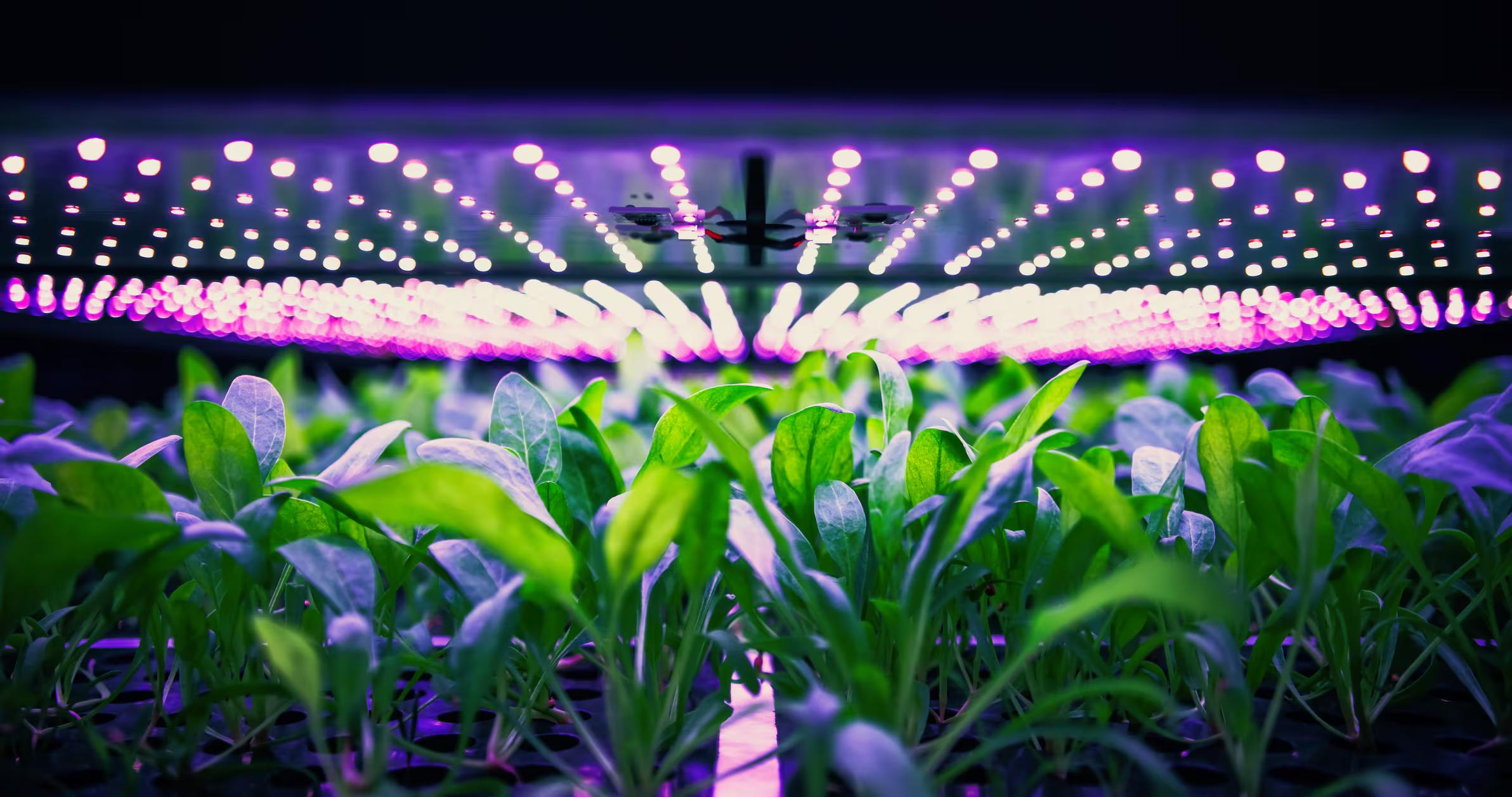




Canopy Microclimates
Recognizing that canopy conditions can differ from broader room conditions.
Vapor Pressure Deficit
Understanding the relationship between temperature, humidity, and the plant environment.

Canopy Airflow Dynamics
Air velocity and air movement influence heat transfer, moisture removal and the conditions experienced by plants.
The Plant Is an Active Load.
The Plant Is an Active Load.
Plants continuously release water vapor into the air through transpiration. This process creates a significant latent load that must be understood in relation to the crop canopy rather than simply as a room-average condition.
Moisture Leaves the Plant
The canopy adds water vapor directly to the surrounding air.
The Air Must Accept That Moisture
The condition of air at the canopy influences the moisture exchange process.
The Load Exists at the Crop
The air distribution strategy determines how directly that load connects to the equipment.
Psychrometrics
Air Carries More Than Temperature.
Psychrometrics describes the relationship between temperature, moisture content, energy and other properties of moist air. These relationships are central to how a CH&D system removes heat and moisture generated by the crop.
Temperature
Dry-bulb temperature describes the sensible thermal condition of air.
Moisture Content
Humidity ratio and vapor pressure describe the moisture carried by air.
Energy
Boundary Layers
The Air Closest to the Leaf Matters.
A relatively thin layer of air surrounds each leaf. This boundary layer can influence the exchange of heat and water vapor between the plant and the broader canopy environment.
Leaf Surface Conditions
The immediate air surrounding the leaf is part of the plant’s actual environment.
Air Velocity Matters
Air movement can influence the thickness and behavior of the boundary layer.
Heat and Moisture Transfer
The boundary between the leaf and surrounding air affects these exchange processes.
Canopy Microclimates
A Room Can Have More Than One Climate.
A sensor located elsewhere in the room may not fully represent the conditions experienced by the crop. Temperature, humidity, vapor pressure and airflow can vary throughout the growing environment.
Room Condition
The general condition measured within the larger enclosed space.
Canopy Condition
The environmental condition where the crop is actively exchanging heat and moisture.
Measurement Location Matters
What a sensor measures depends on where the sensor is placed in the air path.
Vapor Pressure Deficit
Understanding the Moisture Gradient.
Vapor Pressure Deficit is used to describe the difference between the vapor pressure associated with a saturated surface and the actual vapor pressure of the surrounding air. It provides a useful framework for understanding the moisture-transfer environment experienced by the crop.
Temperature and Moisture Are Connected
VPD depends on both temperature and vapor pressure conditions.
It Describes a Driving Difference
The relationship helps explain the potential for moisture movement between plant and air.
Canopy Conditions Matter
The relevant environmental relationship exists where the plant actually interacts with the air.
Canopy Airflow Dynamics
Airflow Is Part of the Crop Environment.
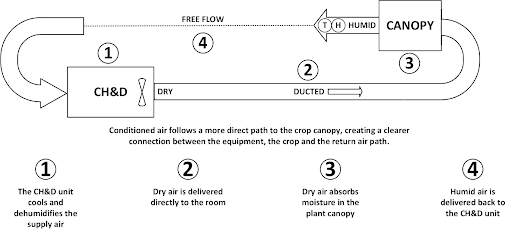
Air distribution is not simply about moving air through a room. The path, velocity and condition of that air influence how directly the climate-control system connects to the crop.
DIRECT AIR PATH
Reduce the distance and dilution between conditioned supply air and the crop canopy.
CANOPY-FOCUSED CONTROL
Use canopy conditions as a more direct reference for environmental control.
ENGINEERING EFFICIENCY
The analyzed example demonstrates potential reductions in calculated HVAC capacity and airflow.
Our FAQs
Frequently Asked Questions
Canopy-Direct™ is an engineered air distribution methodology that delivers conditioned air directly to the crop canopy rather than allowing it to mix throughout the cultivation room. This approach improves environmental precision and supports more efficient HVAC performance.
Traditional systems distribute conditioned air into the entire room before it reaches the crop. Canopy-Direct™ directs air to the canopy first, reducing unnecessary air mixing and providing a more controlled environment around the plants.
The methodology can improve canopy climate control, reduce airflow requirements, optimize HVAC capacity, enhance environmental consistency, and support more efficient operation in Controlled Environment Agriculture facilities.
Our services support Controlled Environment Agriculture, including vertical farms, indoor farms, commercial greenhouses, hydroponic systems, cannabis cultivation, and agricultural research facilities.
Psychrometric analysis evaluates the relationship between air temperature, humidity, moisture content, and energy. It helps engineers design climate control systems that maintain optimal growing conditions while improving energy efficiency.