Data Center Analogy
Data-center cooling offers a useful engineering parallel: when heat loads became concentrated, designers moved from generalized room mixing to targeted supply and controlled return paths. Vertical farms confront a different load source—the crop canopy—yet the same thermodynamic principle applies: deliver conditioned air where heat and/or moisture originate, measure conditions after the load absorbs them, and avoid relying on an uncontrolled room average.
Early data centers cooled the entire room, intending that enough cold air and sufficient mixing would keep equipment in acceptable condition. As power density increased, that assumption became less reliable.
Raised-floor systems improved delivery by bringing cold air closer to the equipment, but they still depended heavily on room-level mixing and average space conditions.
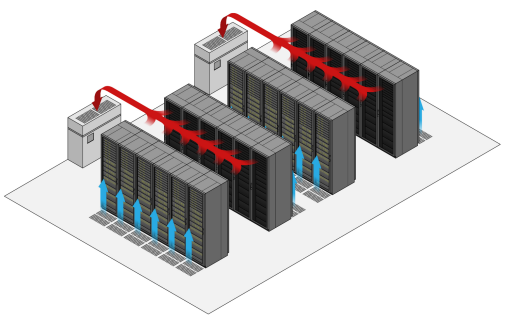
Rack-mounted servers exposed the weakness of that approach: some racks received excess cold air while others developed hot spots. The solution was a hot-aisle/cold-aisle design that separated supply and exhaust air, creating a defined path from the cooling unit to the load and back.
That shift—from mixing the room to controlling the air path—is the relevant lesson for CEA. Direct-to-canopy applies the same logic to vertical farms: supply dry conditioned air directly to the canopy, prevent unnecessary dilution, and use the air leaving the canopy as the meaningful reference for design and control before returning to the CH&D equipment.