THE PROBLEM
Why Traditional Air Distribution Misses the Canopy
Controlled Environment Agriculture is designed to control the environment around the crop. Yet conventional HVACD strategies often begin by controlling the room rather than the canopy.
EXPLORE THE PROBLEM
Understanding the Current Air Distribution Challenge
Before exploring Canopy-Direct™, it is important to understand how conventional room-mixed air distribution works, where the air path becomes indirect, and why room conditions may not always represent the conditions experienced by the crop.
Why Traditional Air Distribution Fails
Conventional systems condition the room and rely on air mixing before conditioned air reaches the crop canopy. This creates a less direct path between the equipment and the plant.
The Hidden Cost of
Air Mixing
Conditioned supply air can be diluted before reaching the canopy, while canopy-leaving air can be blended with room air before returning to the equipment.
Common Industry Misconceptions
A room can meet its temperature and humidity targets while conditions at the canopy tell a different story. The crop experiences its local microclimate—not simply the room average.
The Fundamental Question
If the Crop Is the Load, Why Is the Room the Target?
The crop canopy is where the dominant sensible and latent loads are generated. It is also where temperature, humidity, vapor pressure, VPD and air velocity directly influence plant response.
If the crop is the load, why is the room the primary control target?
THE CONVENTIONAL APPROACH
Two Different Air Paths
The difference begins with where conditioned air travels before it reaches the crop.
ROOM-MIXED
CANOPY-DIRECT™
Room-Mixed Air
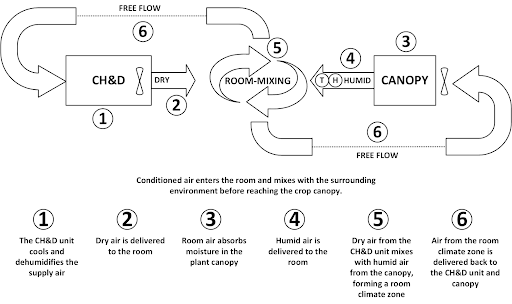
Conditioned air enters the room and mixes with the surrounding environment before reaching the crop canopy.
Canopy-Direct™
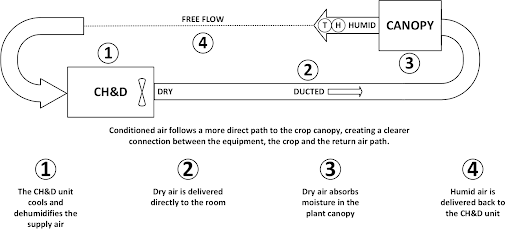
Conditioned air follows a more direct path to the crop canopy, creating a clearer connection between the equipment, the crop and the return air path.
Room Averages Can Hide the Canopy
Where the Conventional Approach Breaks Down
The issue is not that room-mixed systems cannot grow crops. The question is whether the air distribution strategy is directly engineered around the crop canopy.
Designing Around the Room
The room is treated as the dominant climate zone even though the crop canopy is where the major biological and psychrometric processes occur.
Dilution of Conditioned Air
Dry conditioned supply air is diluted by the room environment before reaching the canopy, weakening the direct relationship between equipment and crop.
Humid Air Is Diluted
Air leaving the canopy with added heat and moisture is mixed with room air before returning to the cooling and dehumidification equipment.
Room Averages Can Hide the Canopy
A room can appear to meet a target temperature or humidity while conditions experienced at the canopy are different.
THE HIDDEN COST OF AIR MIXING
The Air Path Changes the Engineering Problem
Every step between the CH&D equipment and the canopy changes the relationship between conditioned air and the crop.
CONDITIONED AIR
In a room-mixed strategy, conditioned air is diluted before reaching the crop. The return path can similarly blend canopy-leaving air before it reaches the equipment.
COMMON INDUSTRY MISCONCEPTIONS
Room Conditions Are Not Always Canopy Conditions
Some common assumptions can make room-average measurements appear more representative of crop conditions than they actually are.
MISCONCEPTION 01
If Room Temperature Is Correct, the Crop Is Correct
Temperature can vary throughout a facility and the condition measured in the room may not represent the air immediately surrounding the canopy.
MISCONCEPTION 02
Room RH Fully Represents Plant Conditions
Relative humidity is only one measurement. Vapor pressure, temperature and airflow at the canopy all influence the plant environment.
MISCONCEPTION 03
Air Mixing Automatically Creates Uniform Conditions
Mixing air throughout a room does not necessarily guarantee that the canopy experiences uniform conditions throughout the crop area.
THE CONSEQUENCE
When the Air Path Becomes Indirect
Less Direct Moisture Management
The relationship between the canopy moisture load and the equipment can become less direct.
Variable Canopy Conditions
Room-average measurements may not fully represent conditions experienced by the crop.
More Complex Control
Measurement and control must account for an intermediate mixed-room climate zone.
Less Defined Air Path
Equipment, airflow and commissioning become less directly connected to the canopy process.
THE QUESTION
What If We Designed the Air Path Around the Crop?
Instead of asking only how to condition the room, the engineering question becomes how to deliver the appropriate conditioned air to the canopy and measure what leaves it.
A DIFFERENT ENGINEERING APPROACH
Meet Canopy-Direct™
Canopy-Direct™ connects the CH&D equipment more directly to the crop canopy and uses canopy-leaving air as a primary reference condition for design, measurement and control.